
Shocking Data: 61% of the World's Cats Are Overweight
According to the Association for Pet Obesity Prevention (APOP), 61% of cats worldwide are classified as overweight or obese. Approximately 33% qualify as "obese" (BCS 8-9/9).
An even bigger problem: 32% of owners don't notice
32% of owners with overweight cats classified their pets as "normal weight." Human eyes tend to confuse "round and cute" with "healthy."
Latest research on indoor living:
A 2026 Frontiers in Veterinary Science study found:
- Indoor cats have significantly higher obesity risk at young ages (1-3 years)
- Stronger owner attachment correlates with higher cat obesity (overfeeding treats)
- Sedentary indoor lifestyle + free-feeding (leaving food out) are the two biggest risk factors
Diseases caused by obesity:
- Diabetes — Obese cats face 4x the risk vs. normal weight
- Arthritis — Weight stress damages joints
- Hepatic lipidosis (fatty liver) — Triggered by rapid weight loss
- Urinary disease — Incidence rises with obesity
- Heart disease — Increased cardiac burden
- Lifespan shortened by 2-3 years
Cat obesity isn't a "cute" problem — it's a life-threatening chronic inflammatory condition.
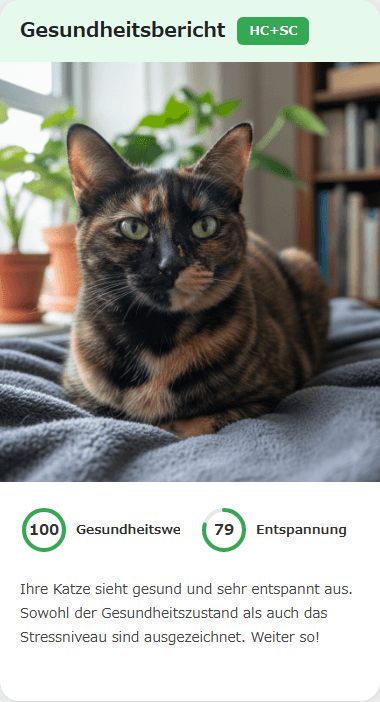

Würden Sie es merken, wenn etwas nicht stimmt?
Katzen verbergen Schmerzen instinktiv. CatsMe prüft per KI ein Foto vom Gesicht Ihrer Katze auf Anzeichen von Schmerz im Ausdruck. Es stellt keine Diagnosen – wenn Sie sich Sorgen machen, wenden Sie sich an Ihre Tierarztpraxis.


How to Correctly Assess Your Cat Using BCS (Body Condition Score)
Scale weight alone cannot determine obesity. Ideal weight varies greatly by breed and skeletal structure. BCS (Body Condition Score) is the global veterinary standard.
Reading BCS (9-point scale):
| BCS | Status | Appearance/Palpation |
|---|---|---|
| 1-3 | Underweight | Ribs visible, hip bones prominent |
| 4-5 | Ideal | Ribs palpable through thin fat layer, visible waist from above |
| 6-7 | Overweight | Ribs hard to feel, waist unclear |
| 8-9 | Obese | Ribs not palpable, hanging belly, round when viewed from above |
3-step home check:
Step 1: Rib check — Lightly stroke your cat's sides.
- Easily felt → Normal/thin
- Felt with slight pressure → Slightly overweight
- Can't feel even with pressure → Obese
Step 2: Waist check — Look down at your cat from above.
- Visible waist → Normal
- Straight line → Slightly overweight
- Bulging outward → Obese
Step 3: Belly check — View your cat from the side.
- Tucked up → Normal
- Slightly drooping → Slightly overweight
- Clearly hanging → Obese (Note: the primordial pouch — a normal skin flap — is NOT an indicator of obesity)
When in doubt, have your veterinarian evaluate BCS at a regular health checkup.
A Practical Guide to Safe Weight Loss
Cat dieting done too rapidly can be life-threatening. Hepatic lipidosis (fatty liver) is triggered by sudden fasting or extreme calorie restriction and has a high fatality rate.
Safe weight loss pace: 1-2% of body weight per week
- A 5kg cat should lose 50-100g per week
- 200-400g per month is safe
- Fasting is absolutely prohibited (2+ days without food risks hepatic lipidosis)
Practical methods:
1. Recalculate feeding amounts (most important)
- Package feeding guides use "ideal weight" — calculating by current weight means overfeeding
- Feed for your cat's "target weight" instead
- See food guide basics
- Stop free-feeding; switch to 2-3 scheduled meals daily
2. Limit treats
- Treats should be under 10% of daily calories
- "They beg for it" is the #1 obesity cause
- Replace treats with play
3. Increase activity
- Indoor exercise strategies are key
- 15 minutes × 2 daily active play sessions with a wand toy
- Cat trees (vertical movement burns more calories)
- Food puzzles — turn meals into "hunts" for exercise + satisfaction
4. Partner with your vet
- Health check before dieting (rule out hypothyroidism and other medical causes)
- Discuss prescription metabolic diets (designed to reduce hunger)
- Monthly weigh-ins and progress checks
Never do this:
- ❌ Suddenly halve food portions
- ❌ Fast for 2+ days
- ❌ Feed human diet foods
- ❌ Force sudden intense exercise (joint stress)
Record changes in your cat's expression with CatsMe
Tackling obesity starts with recording weight and food amounts consistently. CatsMe (by Carelogy Inc.) uses AI to check a photo of a cat's face for signs of pain in its expression. It does not diagnose disease, assess overall health or replace a veterinarian; if you are worried, contact your vet regardless of the result.
- Keep dated records of weight and meals to show your vet
- Records are kept per cat, so it works for multi-cat homes (iOS, Android and web, 14 languages)
- Developed with a background in university joint research; over 1 million checks run to date
Learn more about CatsMe →
Könnten Sie beantworten: ‚Seit wann geht es ihr so?'
CatsMe prüft per KI ein Foto vom Gesicht Ihrer Katze auf Anzeichen von Schmerz im Gesichtsausdruck und speichert datierte Aufzeichnungen pro Katze, die Sie mit Ihrer Tierarztpraxis besprechen können. Es stellt keine Diagnosen.
肥満体重管理ダイエットBCS室内飼い2026
FAQ
 CatsMe
Seien Sie vorbereitet, wenn Ihnen etwas auffällt
Ein Foto genügt: CatsMe prüft per KI das Gesicht Ihrer Katze auf Anzeichen von Schmerz. Führen Sie datierte Aufzeichnungen pro Katze, die Sie mit Ihrer Tierarztpraxis besprechen können. Es stellt keine Diagnosen.