Symptoms2026-08-12Carelogy編集部

Cats in Pain Don't Cry Out — But Their Face Shows It: The 5 Places to Look

Cats hide pain. A cat curled up and quiet is easily misread as calm. The Feline Grimace Scale, validated at the Université de Montréal in 2019, showed that pain shows up in five places on a cat's face — ears, eyes, muzzle, whiskers and head position. Here is how to look, starting today.

Cat health check
Share:𝕏fLINE

Quiet Is Not the Same as Comfortable

A dog in pain vocalises, licks the sore spot, and generally makes it obvious. A cat does not. A cat in pain sits in the corner, curled tight, and goes quiet. Most owners read that as calm, or as sleeping. It is neither. That is what feline pain looks like. Cats evolved as animals that get targeted when they look weak, so they hide pain for as long as they can, keeping up the appearance of normal. Which means that by the time you notice something is wrong, the pain is already past the point of hiding. So is there a way to see it earlier? Recent veterinary research gave an answer: look at the face. Behaviour can be masked. The muscles of the face cannot.
Worried about these symptoms?
CatsMe

Worried about these symptoms?

Don't wait and wonder. CatsMe's AI analyzes your cat's photo to flag health concerns in seconds.

Dipercaya oleh lebih dari 380.000 pemilik kucing di 50 negara

Five Places on the Face — What Montreal Validated

In 2019 a team at the Université de Montréal published the Feline Grimace Scale. They compared video of 35 cats that were genuinely in pain with 20 cats that were not, and identified the facial changes the painful cats shared. There are five places to look. | Where to look | What pain does | |---|---| | Ears | Pulled apart and rotated outwards | | Eyes | Narrowed — the orbital area tightens and the eye looks smaller | | Muzzle | Loses its round shape and looks flattened, stretched | | Whiskers | Pushed forward, or standing on end | | Head | Held below the shoulder line, or tilted down | Each one is scored as absent, moderate, or obvious. They do not all have to appear at once. What matters is how many have changed compared with how your cat normally looks. The scale correlates very strongly with another pain assessment used by vets (rho = 0.86), and different people scoring the same cat tend to agree. In other words this is a reproducible way of looking, not an impression. Source: Evangelista MC et al., Scientific Reports, 13 December 2019. The scale's official site (free) is felinegrimacescale.com.

What Else Leaks Through

A few non-facial changes are worth watching alongside. In every case the test is "compared with normal for this cat". - Objecting to being picked up, or to being touched in one particular place — a cat that suddenly will not let you touch a spot is often sore there - Eating less — with mouth pain, cats often approach the bowl, look interested, and then not eat - Grooming less (a dull, unkempt coat), or over-grooming one spot - No longer jumping up, or hesitating before a jump — common with joint pain - Going outside the litter box — stepping over the rim hurts, or urinating itself hurts - Hiding more (why cats hide) One of these alone can just be a mood. Several at once, lasting several days, is a reason to see a vet.

The Limits, Stated Plainly

This way of looking has clear limits, and they are worth stating. 1. What was validated is acute pain. The study looked at pain from injury and acute illness. Chronic pain — arthritis over years — was not assessed by this method. Chronic pain tends not to show on the face; changes in daily life (stopped jumping, sleeps somewhere new) are the better clue. 2. It can tell you there is pain. It cannot tell you why. Noticing the face has changed does not tell you whether it is a tooth, the abdomen, or a joint. Assessment is not diagnosis. 3. Cats also change their faces for other reasons. Stress at the clinic, heat, sleepiness — all move the ears and eyes. Which is exactly why this depends on knowing what your own cat's face normally looks like. If you think your cat is in pain, never give human painkillers. Paracetamol (acetaminophen) and ibuprofen can kill a cat even in small amounts.

You Don't Have to Memorise the Normal Face — CatsMe

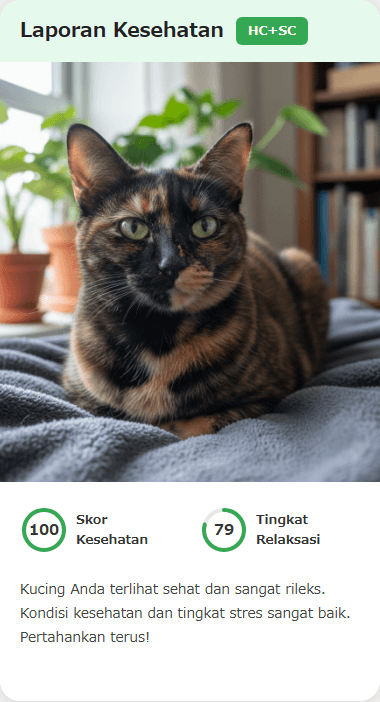
The weakness of this method is that it only works if you know what normal looks like for your cat — and the face you see every day is the hardest one to notice change in. That is what a record is for. CatsMe reads your cat's expression from a single phone photo and assesses pain and health with AI. It does the "look at the face" described above with a record instead of your memory. - 📸 AI pain & health check from one photo — just snap, in seconds - 💬 AI chat health assistant — ask the moment you're worried - 🩺 Online consultations with licensed vets — reach a pro when needed - 📈 A record that answers "since when?" — show it at the clinic as it is Every vet asks the same first question: *when did this start?* Whether you can answer it changes how fast you get to a diagnosis. Used in 50+ countries. → Start monitoring your cat with CatsMe
CatsMe

Bisakah Anda menjawab "sejak kapan ini terjadi?"

Saat dokter hewan bertanya, jangan sampai Anda bingung. CatsMe mencatat skor kesehatan harian secara otomatis yang bisa dibagikan hanya dengan satu ketukan.

痛みサイン行動早期発見Feline Grimace Scale
Share:𝕏fLINE

FAQ

Siap bertindak saat Anda merasa ada yang tidak beres
CatsMeCatsMe

Siap bertindak saat Anda merasa ada yang tidak beres

Cukup satu foto: AI membaca rasa sakit dan kondisi kesehatan dari ekspresi kucing Anda. Periksa saat Anda mulai khawatir, dan bagikan catatannya ke dokter hewan.