

Why Do Cats Purr?
Purring is produced by the rhythmic contraction of muscles in a cat's larynx, generating vibrations at frequencies between approximately 25 and 150 Hz. Cats purr in several distinct contexts:
Contentment and relaxation: The most common reason. You will hear it while petting, when your cat is in your lap, or when they are settled in a warm spot.
Solicitation: A "feed me" or "open the door" request. Research suggests the solicitation purr contains a slightly higher frequency component that resembles a human baby's cry, making it hard to ignore.
Self-healing: Purring may promote bone repair and wound healing. Studies have shown that vibrations in the 25–50 Hz range support bone density maintenance.
Pain or distress: Surprisingly, cats also purr when they are hurting or stressed. This appears to be a self-soothing mechanism — the feline equivalent of humming to calm oneself.
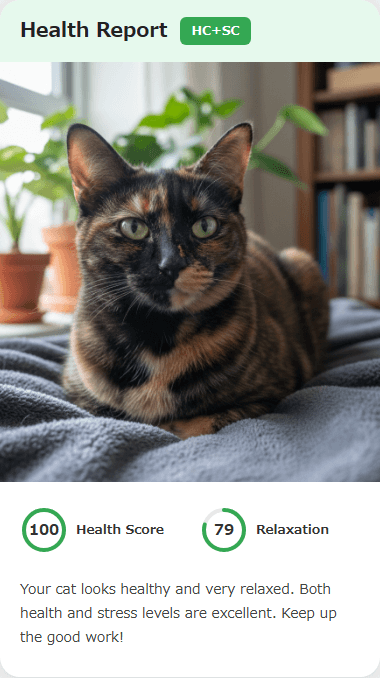

Your cat's daily companion
From grooming reminders to weight trends, CatsMe keeps your cat's care routine on track — all in one app.
Used by 380,000+ cat owners in 50 countries


Health Benefits of Purring
A cat's purr offers health benefits not only to the cat but also to its owner.
Benefits for cats: Promotes bone repair, relieves pain, accelerates wound healing, and reduces stress.
Benefits for humans: Studies have linked cat ownership to lower blood pressure, reduced cortisol (the stress hormone), and a decreased risk of cardiovascular disease. One widely cited study found that cat owners had a 40% lower risk of heart attack compared to non-owners.
The healing vibration of a cat's purr is one of the key reasons why living with a cat is considered good for your health.
When Purring Is a Warning Sign
A purring cat is not always a happy cat. See your veterinarian if you notice any of the following:
- Purring while refusing food — may be masking pain
- Purring while hiding — often indicates illness
- Purr that sounds different (raspy, interrupted, or strained) — could signal a respiratory issue
- Purring combined with rapid breathing — may point to heart or lung disease
Always evaluate purring in the context of your cat's overall body language rather than taking it at face value.
Step-by-Step Guide to Distinguishing Different Purrs
Cats produce different types of purrs with distinct meanings. Follow these steps to distinguish between them.
Step 1: Note the pitch. Low-frequency purring indicates deep relaxation. A purr with a slightly higher-pitched component mixed in typically signals a solicitation for food.
Step 2: Assess the situation. Purring during petting means contentment. Purring near mealtime is a request. Purring while appearing unwell suggests self-soothing.
Step 3: Cross-reference with other body language. Purring combined with slow blinking equals happiness. Purring while hiding may indicate illness.
Step 4: Compare with your cat's normal purr. A change in quality such as raspiness or interruptions could signal a respiratory issue.
Common Misconceptions About Cat Purring
Clear up these widespread misconceptions about cat purring.
Misconception 1: Purring always equals happiness. Cats purr during pain and distress as a self-soothing mechanism. Always interpret it alongside other cues.
Misconception 2: Cats that don't purr are unhappy. Some cats simply do not purr audibly and express affection in other ways.
Misconception 3: Sick cats stop purring. Many cats purr more when ill as a form of self-healing.
Misconception 4: Louder purring means greater happiness. Volume is an individual trait, not a measure of contentment.
Expert Tips on Understanding Your Cat's Purr
Feline behavior experts recommend these approaches for understanding and benefiting from your cat's purr.
Keep a purr diary. Recording the circumstances of each purring episode reveals your cat's patterns over time.
Manage solicitation purring. If your cat purrs to demand food, responding unconditionally escalates the behavior. Maintain a consistent feeding schedule.
Leverage the healing benefits. Cat purring at 25–50 Hz has been linked to improved bone density and lower blood pressure in humans.
Watch for changes in senior cats. If an older cat's purr changes in quality, hyperthyroidism or respiratory disease may be developing. Mention the change at your next checkup.
Turn today’s care into a daily habit
Grooming, weight trends, appetite — CatsMe keeps it all in one place so subtle changes never slip by.
ゴロゴロパーリング気持ちコミュニケーション
FAQ
 CatsMe
Be ready the moment you sense something's off
Take one photo and the AI reads pain and condition from your cat's expression. Check the moment you wonder, and share the record with your vet.