
News & Trends2026-05-19Carelogy編集部
May 2026 Cat Medical News Roundup: Vet DX, Infection Trends, New Drugs & Blood Donor Cats
Curated roundup of 5 cutting-edge cat medical news from May 2026: pharmacist-vet collaboration, animal hospital DX, hantavirus response, eye infection care, blood donor demand, and pet industry macro trends. Carelogy editorial perspective with what cat owners should know now.

Bottom Line: May 2026 Cat Medical Trends in 3 Lines
1. Animal hospital DX is accelerating — pharmacist-vet collaboration, wholesale-hospital co-branding, and group consolidation (Hikarigaoka × JPAC) are happening simultaneously. A turning point that changes treatment quality and choices reaching owners.
2. Zoonotic infection alert levels are rising — international hantavirus dynamics, viral feline eye infection cases, Tokachi Veterinary Association public lectures — time to reassess outdoor exposure risks.
3. Social demand for blood donor animals is surging — as dogs and cats age, the role of 'donor cats and dogs' in life-saving medicine expands, alongside parallel ethical debate.
This article curates cat medical news reported May 10-18, 2026, selecting 5 stories the Carelogy editorial team considers 'most likely to affect owner decisions.' Each section has a three-layer structure: source citation + 3-line summary usable in vet consultations + Carelogy's editorial perspective.


① Pharmacist-Vet Collaboration Expands — A New Chapter in Veterinary Drug Safety
Source: Yakudoku 2026-05-18 / 'Expanding contact between pharmacists and veterinary medicine — educational systems hold the key'
3-line summary:
- Pharmacists are formally engaging in safe dispensing and medication guidance for veterinary drugs
- Multiple adverse events have been reported from misadministration or self-judgment use of pet medications
- Establishing pharmacist education programs (veterinary drug basics, human-animal drug interactions) is the challenge
Carelogy perspective:
In cat medicine where human drugs are often repurposed at vet discretion (kidney drugs, thyroid meds, antihypertensives), standardizing 'pharmacist dispensing infrastructure' would reduce prescription errors and contraindication exposure. Especially in senior cats on multi-drug regimens (therapeutic diet + fluids + phosphate binder + antihypertensive + analgesic), pharmacist interaction-checks directly prevent incidents. Within 3-5 years, neighborhood pharmacies handling both 'human and animal medications' may become standard.
What owners can do now:
- Record vet-prescribed drugs in a pet medication record book
- Do NOT give over-the-counter human drugs (antipyretics, cold medicines, etc.) to cats without vet direction
- For senior cats on multiple drugs, ask the primary vet about therapeutic diet interactions
- Cats with chronic conditions like CKD should always share medical history when prescriptions change
② Animal Hospital DX Accelerates — Petgo × Signi, Hikarigaoka × JPAC, Wholesaler-Hospital Integration Deepens
Sources: PR TIMES 2026-05 / Fukushima Minyu Shimbun 2026-05
3-line summary:
- Petgo co-branding with major hospital group Signi, jointly developing exclusive products
- Hikarigaoka Animal Hospital Group (IDC Inc.) joins JPAC, expanding network to 45 facilities across 14 prefectures
- Trend is clear: from solo-operated clinics to group consolidation prioritizing 'specialization, purchasing power, data sharing'
Carelogy perspective:
Over the past year, a structural shift from 'solo private clinics' to 'network hospital groups' has accelerated. Two-way impact on owners:
Positive:
- Smoother referral pathway to specialists (cardiology, nephrology, oncology, etc.)
- More choices in diagnostic equipment and treatments (blood test sophistication rises)
- Better access to exclusively-stocked new drugs and supplements
- Group-internal night emergency network secured
Negative / cautions:
- Primary vet's approach may change (group-internal standardized protocols)
- Treatment fee structures may be revised (bundled vs. itemized)
- Familiar veterinarians may transfer
What owners can do now:
- Confirm which group your primary clinic belongs to
- Confirm whether referral clinics are within or outside the group, and your choice
- Ask your primary vet about second-opinion procedures
③ Zoonotic Disease Alert Level Rises — Hantavirus, Eye Infections, Regional Education
Sources: Yomiuri Shimbun 2026-05 / Asahi Shimbun 2026-05 / Tokachi Mainichi 2026-05 / LIMO 2026-05
3-line summary:
- Government provides stockpiled Avigan to UK for hantavirus countermeasures; animal trials show efficacy when administered within 4 days of infection
- Asahi Shimbun features 'wildlife viruses entering living areas' deepening biosecurity discussion
- Tokachi Veterinary Association hosts 'Human-Animal Infections' public lecture May 29 — regional education movement
- Eye-infection kitten's treatment journey draws major response, highlighting importance of appropriate care
Carelogy perspective:
Major zoonotic concerns via cats are SFTS (first feline case in Chiba May 2026), FIV/FeLV, and toxoplasmosis. The hantavirus international report should be read as 'low domestic risk currently, but alert lines raised for outdoor-cat-mediated wildlife virus exposure.'
4 actions for indoor cat owners:
1. Maintain fully indoor housing — outdoor contact is a source of SFTS, toxoplasmosis, rabies, and various viruses
2. Reduce contact opportunities with stray cats — yard intrusion countermeasures, no feeding
3. Maintain regular vet visits — early detection is the strongest weapon
4. Don't overlook eye discharge, sneezing, breathing abnormalities — kitten eye infections are curable with early treatment; neglect risks blindness
For those welcoming a new kitten:
For rescue or adopted cats, always have infection screening (FIV/FeLV/cat flu/fungus). With existing cats, set a 2-week quarantine period.
④ Surging Demand for Blood Donor Cats — Aging Cats Meet Life-Saving Medicine Reality
Source: TV Asahi NEWS 2026-05 / 'Blood donor dogs saving sick animals — demand surges with aging, fighting for minutes and seconds'
3-line summary:
- Blood transfusion demand surges in life-saving medicine for aging dogs and cats; donor animal shortage deepens
- Emergency surgery, severe anemia, end-stage CKD and other minutes-counting scenarios increasing
- Animal hospitals with donor registration systems are growing, but social awareness remains low
Carelogy perspective:
In cats, transfusion is even harder than dogs — 'rapidly securing a blood-type-matched donor cat' is the key to saving lives. Cats have three main blood types: A, B, and AB. Incompatible transfusion causes fatal hemolytic reactions, so secondary care facilities maintain registered donor cats.
Owner options:
A. Register your own cat as a donor
- Requirements: 1-8 years old, ≥4 kg, indoor-only, vaccinated, healthcheck-cleared
- Donation: max 10 ml per kg body weight (4 kg cat → max 40 ml), max 1-2 times per year
- Benefits: free healthcheck, treatment-fee discount at the registered hospital (varies)
- Risks: stress during draw, very rarely hypotension
B. Secure a 'same-species partner' for your own cat
- In multi-cat households or among cat-owning friends, secure 'mutual donor partners for emergencies'
- Know blood types in advance (can be tested concurrently at health checkup)
C. Make a hospital with a donor bank your primary
- Choose secondary care or specialty medical center networks
- Emergency response speed differs significantly
Action item now:
At the annual health checkup, request 'I'd like to test my cat's blood type.' Tests cost ¥1,500-3,000. Critical information in emergencies.
⑤ Pet Industry Macro Trends — Zoetis Earnings and Declining Vet Visits
Source: Kabutan 2026-05 / 'Zoetis tumbles on earnings as pet owner vet visits decline'
3-line summary:
- Zoetis (world's largest veterinary drug maker) reports declining US pet owner vet visits
- Stock plunges; recession concerns spread across pet medical industry
- Household budget pressure causing 'deferring preventive visits' cited as a factor
Carelogy perspective:
This trend may manifest similarly in Japan, warranting attention. US data indicates a negative spiral: declining visits → delayed early detection → severe progression → high-cost treatment → further visit avoidance.
Defensive measures for Japanese owners:
1. 'Do not skip preventive visits' — health checkups and vaccinations are far cheaper than emergency treatment
2. Review pet insurance — adoption is still low in Japan (~15%), worth considering
3.
4. Start home health records — dated notes on weight, meals and behaviour help you act when it is truly needed
Carelogy's suggestion:
Rather than reducing absolute number of vet visits, an operation that 'concentrates on valuable visits' best balances household budget and feline health. Combining daily records with advice from your vet reduces unnecessary anxiety and over-visits while helping you avoid missing critical moments.
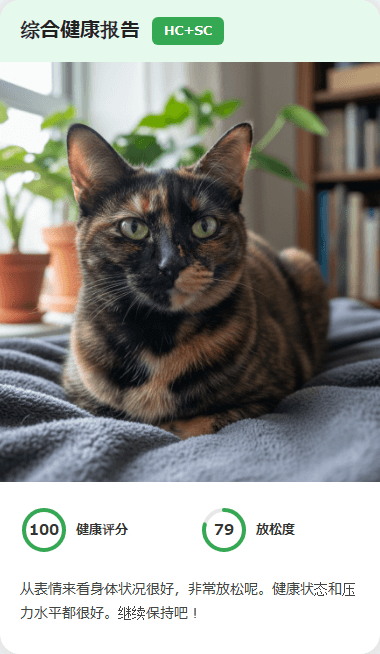
Record changes in your cat's expression with CatsMe
When you apply medical news to your own cat, records of weight, meals and vet visits make it easier to consult your vet. CatsMe (by Carelogy Inc.) uses AI to check a photo of a cat's face for signs of pain in its expression. It does not diagnose disease, assess overall health or replace a veterinarian; if you are worried, contact your vet regardless of the result.
- Keep dated records of weight, meals and vet visits and vaccinations to show your vet
- Records are kept per cat, so it works for multi-cat homes (iOS, Android and web, 14 languages)
- Developed with a background in university joint research; over 1 million checks run to date
Learn more about CatsMe →

兽医问「什么时候开始的?」你答得上来吗?
CatsMe 用 AI 检查猫咪面部照片,查看表情中是否有疼痛迹象,并为每只猫保存带日期的记录,方便与兽医一起查看。它不能诊断疾病。
最先端ニュース獣医療DX感染症供血ドナー薬剤師動物病院ペット業界20265月
FAQ
