

The Bottom Line: Every Behavior Problem Has a Reason — Rule Out Medical Causes First
What we label "problem behavior" is almost always a rational response to stress or discomfort from your cat's perspective.
Start by visiting your veterinarian to rule out medical causes. Spraying may stem from a bladder infection, aggression from hidden pain, and nighttime vocalization from hyperthyroidism — these scenarios are surprisingly common. Once health issues are off the table, environmental modifications and behavior therapy can resolve most problems effectively.

Your cat's daily companion
From grooming reminders to weight trends, CatsMe keeps your cat's care routine on track — all in one app.
Dipercaya oleh lebih dari 380.000 pemilik kucing di 50 negara


Solving Spraying and Inappropriate Elimination
First, check the basics: Is your litter box setup adequate?
Medical causes: FLUTD, cystitis, or kidney disease should be ruled out with blood and urine tests.
Environmental causes and fixes:
- Number of boxes: The rule is one per cat, plus one extra. If you only have one, add more
- Cleanliness: Scoop daily and replace all litter weekly
- Location: Place boxes in quiet, safe areas — never next to a noisy washing machine
- Litter type: If you recently switched brands, switch back
- Multi-cat stress: Evaluate relationships between cats and ensure plenty of resources (litter boxes, food bowls, resting spots)
Neutering: Spraying by intact male cats resolves in about 90% of cases after spay/neuter surgery.
Dealing with Aggression: Biting and Scratching
Identify the type of aggression:
Play aggression: Common in young cats that treat hands and feet as prey. The fix: increase interactive play with toys — never use your hands. Dedicate 15 to 30 minutes a day to indoor exercise.
Fear/defensive aggression: A response when the cat feels cornered. The fix: always provide an escape route and never force interaction.
Petting-induced aggression: The cat seems to enjoy being petted, then suddenly bites. The fix: learn to read body language — a twitching tail tip or flattened ears signal the cat has had enough. Keep petting sessions short.
Pain-related aggression: The cat bites when a specific body part is touched. The fix: see your vet. Arthritis or dental pain could be the underlying cause.
What you should never do: Hitting or yelling only escalates fear-based aggression and destroys trust.
Nighttime Vocalization: Causes and Solutions
Senior cat vocalization: Could indicate cognitive dysfunction syndrome (feline dementia). Talk to your vet about supplements and environmental enrichment strategies.
Hyperthyroidism: If a senior cat shows increased activity, ravenous appetite, weight loss, and nighttime yowling together, a blood test is strongly recommended.
Insufficient exercise: Not enough daytime play leads to pent-up energy at night. Try a focused 15-minute play session right before bedtime.
Hunger: If your cat wakes you for food, an automatic feeder dispensing a small portion in the middle of the night can solve the problem.
Heat cycles: Intact cats in heat will vocalize loudly. Spay/neuter surgery is the definitive fix.
A word of caution: Nighttime crying is frequently a sign of an underlying medical condition, so always get a veterinary check-up before assuming it is purely behavioral.
Diagnosing Behavior Problems & the Cost of Behavioral Therapy
Resolving behavior problems requires a systematic approach: first rule out medical causes, then conduct a behavioral assessment.
Medical workup costs:
- Blood tests (thyroid, kidney, liver function): $40 to $120 (¥5,000–15,000). Essential for any senior cat with behavior changes.
- Urinalysis (to rule out cystitis): $15 to $30 (¥2,000–4,000). Necessary when inappropriate urination is involved.
- Imaging (as needed): $40 to $80 (¥5,000–10,000).
Behavioral therapy options:
- Environmental enrichment: Cat trees, hiding spots, and new toys. Initial investment of $40 to $250 (¥5,000–30,000).
- Feliway (synthetic pheromone): Diffuser costs $25 to $40 (¥3,000–5,000), with monthly refills at $15 to $25 (¥2,000–3,000).
- Board-certified veterinary behaviorist consultation: $80 to $250 (¥10,000–30,000). Recommended for complex or persistent cases.
- Anti-anxiety medication: Prescribed when needed, roughly $15 to $40 per month (¥2,000–5,000).
A critical principle: Punishment for behavior problems is never appropriate. It increases fear and makes the behavior worse. Positive reinforcement — rewarding desirable behavior with treats and praise — is the only evidence-based approach.
Carelogy's online veterinary consultation makes it easy to discuss behavioral concerns without the stress of a clinic visit.
Behavior Problems in Multi-Cat Households: Improving Feline Relationships
Multi-cat households are one of the most common triggers for behavior problems. Cats are naturally solitary animals, and being forced to share territory can be a chronic source of stress that manifests as spraying, aggression, or withdrawal.
Resource distribution is the foundation:
- Litter boxes: One per cat plus one extra (four boxes for three cats)
- Food and water bowls: Placed in separate locations for each cat
- Resting spots: Each cat needs a place to retreat and relax without being watched by other cats
- Scratching posts: Multiple stations throughout the home
Signs of inter-cat tension:
- Staring contests (subtle but significant)
- One cat "blocking" access to pathways, litter boxes, or food
- One cat increasingly hiding or withdrawing
- Sudden onset of spraying or urinating outside the litter box
Introducing a new cat: Allow a minimum of two weeks for a gradual introduction. Start with complete separation in different rooms, then progress through scent-swapping, brief supervised visual contact, monitored free time together, and finally full integration.
When problems persist despite intervention: Consult a veterinary behaviorist. In some cases, certain cats are simply incompatible, and permanently separating their living spaces may be the most humane and practical solution.
Long-Term Behavior Management: Putting Environmental Enrichment into Practice
The most effective long-term approach to preventing and resolving behavior problems is environmental enrichment — creating a home that satisfies a cat's fundamental instinctive needs.
Five core needs every cat has:
1. Elevated spaces: Cat trees, wall-mounted shelves, and tall furniture. Cats feel secure when they can survey their territory from above.
2. Hiding spots: Boxes, tunnels, and covered nooks. These serve as safe retreats during stressful moments.
3. Hunting simulation: Interactive play sessions (15 to 30 minutes per day) and puzzle feeders that make the cat work for food.
4. Scratching surfaces: Both vertical and horizontal options. Experiment to discover your cat's preferred material — sisal, cardboard, or carpet.
5. Visual stimulation: A window perch where the cat can watch birds and outdoor activity. This provides mental engagement during quiet hours.
Tips for higher-quality play sessions:
- Move wand toys like real prey — erratic movements, hiding behind furniture then darting out
- End each session with a small meal or treat (this completes the natural hunt-catch-eat cycle and leaves the cat satisfied)
- Rotate toys regularly to prevent boredom
Using technology to track progress: Log behavior incidents in the CatsMe app and monitor changes after environmental modifications. Having objective data makes it much easier to identify which interventions are working and which need adjustment.
Bisakah Anda menjawab "sejak kapan ini terjadi?"
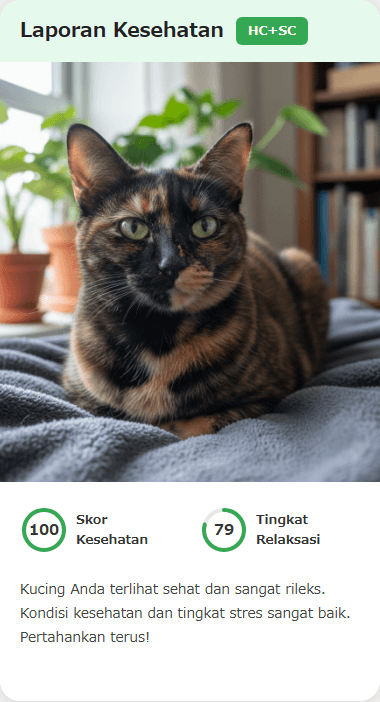
Saat dokter hewan bertanya, jangan sampai Anda bingung. CatsMe mencatat skor kesehatan harian secara otomatis yang bisa dibagikan hanya dengan satu ketukan.
問題行動スプレーマーキング噛む夜鳴き猫の行動
FAQ
 CatsMe
Siap bertindak saat Anda merasa ada yang tidak beres
Cukup satu foto: AI membaca rasa sakit dan kondisi kesehatan dari ekspresi kucing Anda. Periksa saat Anda mulai khawatir, dan bagikan catatannya ke dokter hewan.