
Prevention2026-04-14
Is My Cat Overweight? 5-Step BCS Check + Safe Diet Plan (Vet 2026)
60%+ of indoor cats are overweight. Use the 9-point Body Condition Score (BCS) at home in 30 seconds. Get ideal weight by breed, safe 1% weekly loss target, and prescription diet options vs. food restriction. Vet-supervised.

Is My Cat Overweight? Here's How to Tell in 30 Seconds
Over 60% of pet cats in developed countries are overweight or obese, according to the Association for Pet Obesity Prevention. That makes excess weight the single most common health problem in domestic cats — more prevalent than dental disease, kidney disease, or any infection. And yet most owners do not realize their cat is overweight because we have normalized larger body sizes.
Here is a quick three-step check you can do right now, no scale needed:
1. The rib test. Place your hands on your cat's sides with gentle pressure. You should be able to feel individual ribs easily, like running your fingers across the back of your hand. If you need to press firmly to find the ribs, or cannot feel them at all, your cat is carrying excess fat.
2. The waist test. Look at your cat from above. A healthy cat has a visible hourglass waist — a gentle taper behind the ribs before the hips. If your cat's body is oval or rectangular from above with no waist definition, they are likely overweight.
3. The belly test. View your cat from the side. The belly should tuck up slightly from the chest toward the hind legs. A belly that hangs down, sways when walking, or forms a pronounced pouch (beyond the normal primordial pouch) indicates excess weight.
If your cat fails two or more of these checks, read on to learn about Body Condition Scoring — the veterinary gold standard for assessing feline body composition.
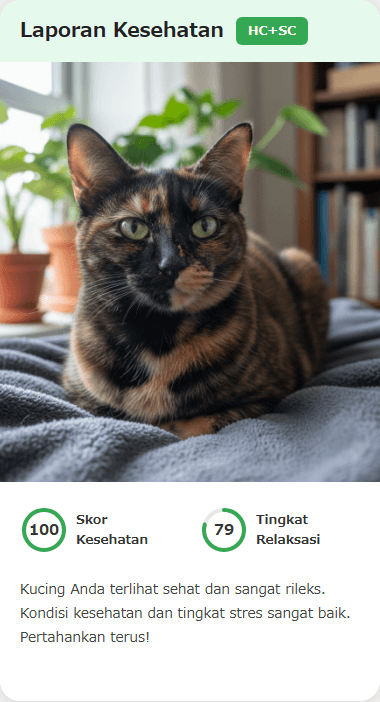

Catch problems before they start
Daily health tracking makes early detection possible. CatsMe logs changes automatically so small shifts don't slip past you.
Dipercaya oleh lebih dari 380.000 pemilik kucing di 50 negara


Body Condition Score (BCS): The Veterinary Standard
Veterinarians assess weight using a Body Condition Score (BCS) — a standardized scale that evaluates fat coverage over key body landmarks. The most widely used system is the 9-point scale developed by Purina and Nestlé, where:
- BCS 1-3: Underweight. Ribs, spine, and hip bones visibly protruding. Obvious loss of muscle mass. No palpable fat. At BCS 1, the cat appears emaciated.
- BCS 4-5: Ideal weight. Ribs easily felt with minimal fat covering. Visible waist from above. Slight abdominal tuck from the side. BCS 5 is the target for most cats.
- BCS 6-7: Overweight. Ribs difficult to feel under a moderate fat layer. Waist barely visible or absent. Abdomen rounded. At BCS 7, the cat is approximately 20% over ideal weight.
- BCS 8-9: Obese. Ribs cannot be felt. No waist. Prominent belly. Fat deposits visible on the neck, limbs, and face. At BCS 9, the cat is 40%+ over ideal weight and at serious health risk.
Each BCS point above 5 represents roughly 10-15% excess body weight. So a cat scored at BCS 7 is about 20-30% heavier than its ideal.
To score your cat at home, feel (do not just look) along the rib cage, spine, and belly. Compare what you feel to the visual charts available from veterinary nutrition companies. Your veterinarian can confirm the score during any wellness visit.
A BCS assessment is more reliable than weight alone because ideal weight varies hugely by frame size. A large-framed male cat might be healthy at 6kg while a petite female of the same breed is obese at 5kg.
Ideal Weight by Breed and the Health Risks of Obesity
While BCS is more informative than weight alone, knowing your breed's typical range provides a useful starting point:
Typical ideal weight ranges:
- Domestic Shorthair/Longhair — 3.5 to 5.5 kg (8-12 lbs)
- Siamese — 3.0 to 5.0 kg (6.5-11 lbs)
- Persian — 3.5 to 5.5 kg (8-12 lbs)
- Maine Coon — 5.5 to 8.0 kg (12-18 lbs); some males reach 10kg healthily
- Ragdoll — 4.5 to 7.0 kg (10-15 lbs)
- British Shorthair — 4.0 to 7.0 kg (9-15 lbs)
- Bengal — 3.5 to 6.5 kg (8-14 lbs)
- Scottish Fold — 3.0 to 5.5 kg (6.5-12 lbs)
Why obesity is so dangerous for cats:
Excess weight is not merely cosmetic — it actively shortens your cat's life by 2-3 years and dramatically increases the risk of:
- Type 2 diabetes — obese cats are 4x more likely to develop diabetes. The silver lining: many diabetic cats achieve remission with weight loss alone
- Arthritis and joint pain — extra weight stresses joints, especially in the hips, knees, and elbows, reducing mobility and quality of life
- Hepatic lipidosis (fatty liver) — paradoxically, overweight cats that suddenly stop eating are at highest risk for this life-threatening liver condition
- Urinary tract disease — obesity increases the risk of bladder stones, urinary blockage, and feline lower urinary tract disease (FLUTD)
- Shortened lifespan — a landmark study found that cats maintaining ideal weight lived an average of 2.5 years longer than overweight cats
- Difficulty grooming — obese cats cannot reach their hindquarters, leading to matted fur, skin infections, and urinary tract infections
Safe Weight Loss Plan: How to Help Your Cat Lose Weight
Cat weight loss must be gradual and controlled. Crash diets are dangerous for cats — losing weight too quickly triggers hepatic lipidosis (fatty liver disease), which can be fatal. The safe rate is 1-2% of body weight per week, meaning a 6kg cat should lose no more than 60-120g per week.
Here is a step-by-step weight loss plan:
Step 1: Get a veterinary assessment. Before starting any diet, have your vet confirm your cat's BCS, rule out medical causes of weight gain (hypothyroidism is rare in cats but possible, and some medications cause weight gain), and calculate a target calorie intake.
Step 2: Calculate daily calories. Most indoor cats need 20-25 calories per pound of ideal (not current) body weight per day. For a cat whose ideal weight is 4.5kg (10 lbs), that is roughly 200-250 calories per day. Your vet can provide a precise number.
Step 3: Measure every meal. Use a kitchen scale, not a scoop. Most cat food scoops dramatically over-portion. Divide the daily amount into 2-3 meals to prevent begging and manage hunger.
Step 4: Eliminate or reduce treats. Treats should be no more than 10% of daily calories. One dental treat can be 30+ calories — that is 12-15% of some cats' daily needs. Switch to low-calorie treats or use small pieces of cooked chicken breast.
Step 5: Increase activity. Dedicate 15-20 minutes per day to interactive play with wand toys, laser pointers (always end with a physical toy to "catch"), or puzzle feeders that make cats work for their food.
Step 6: Weigh weekly. Use a baby scale or kitchen scale for accuracy. Log the weight in the CatsMe app to track the trend. If weight loss stalls for 3+ weeks, consult your vet to adjust the plan.
Monitor Your Cat's Weight Journey with CatsMe
Weight management is a marathon, not a sprint — and having the right tracking tools makes all the difference between success and frustration. The CatsMe app is designed to make feline weight monitoring simple, visual, and actionable.
How CatsMe supports weight management:
- Weight trend graphs — log weekly weigh-ins and see your cat's progress on an easy-to-read graph. The visual trend keeps you motivated and catches plateaus early
- AI facial expression analysis — as your cat loses weight, their comfort level may change. CatsMe's AI detects signs of hunger-related stress or pain from increased activity, helping you adjust the pace
- Daily health scores — track energy levels and appetite alongside weight. A cat that is losing weight but becoming lethargic needs veterinary reassessment
- Calorie logging — record meals and treats to stay within your vet's recommended daily allowance. It is easy to underestimate calories, especially from treats and table scraps
- Vet-ready reports — share your cat's complete weight history, food intake, and activity data with your veterinarian in one tap. Data-driven vet visits lead to better outcomes
- Progress milestones — celebrate when your cat drops a BCS point. Small wins keep the plan on track over months
A study in the Journal of Feline Medicine and Surgery found that cats whose owners tracked food intake and weight weekly were 3x more likely to reach their target weight compared to those who did not track.
Start your cat's weight management journey with CatsMe →
Common Mistakes in Cat Weight Management
Cat owners frequently make these errors when managing their cat's weight, undermining their best efforts.
Mistake 1: Normalizing 'pleasantly plump.' While chubby cats may look endearing, obesity increases diabetes risk by 4x and shortens lifespan by 2–3 years. It is a serious medical condition.
Mistake 2: Crash dieting. Cutting more than 50% of caloric intake triggers hepatic lipidosis (fatty liver disease), which can be fatal. Reduce by 10–15% at a time.
Mistake 3: Estimating portions by eye. Scooping by eye typically overfeeds by 20–30%. Use a kitchen scale for every meal.
Mistake 4: Underestimating treat calories. A single treat can contain 30+ calories. Keep treats below 10% of daily caloric needs.
Mistake 5: Relying on exercise alone. Without dietary changes, exercise alone rarely produces meaningful weight loss. Approximately 80% of weight management success comes from diet control.
When to Consult a Vet About Your Cat's Weight
Consult your veterinarian about weight issues in the following situations.
BCS of 7 or higher. Moderate to severe obesity should be managed under veterinary supervision to avoid the risk of hepatic lipidosis.
Rapid weight gain. More than 5% increase in a single month may indicate an endocrine disorder. Blood work can identify the cause.
Abnormal signs during dieting. Lethargy, vomiting, or jaundice (yellow tinge to the whites of the eyes or ears) are warning signs of hepatic lipidosis. Seek immediate care.
Unexplained weight loss. Losing weight without dieting warrants testing for kidney disease, hyperthyroidism, diabetes, and cancer.
Weight loss plateau lasting 3+ weeks. The plan needs professional reassessment to account for individual metabolic variation.
Bisakah Anda menjawab "sejak kapan ini terjadi?"
Saat dokter hewan bertanya, jangan sampai Anda bingung. CatsMe mencatat skor kesehatan harian secara otomatis yang bisa dibagikan hanya dengan satu ketukan.
cat overweight猫 肥満cat dietBCS 猫cat weight loss猫 ダイエット
FAQ
 CatsMe
Siap bertindak saat Anda merasa ada yang tidak beres
Cukup satu foto: AI membaca rasa sakit dan kondisi kesehatan dari ekspresi kucing Anda. Periksa saat Anda mulai khawatir, dan bagikan catatannya ke dokter hewan.