
News & Trends2026-05-05Carelogy編集部
2026 Cat Health AI Technology Trends: FDA-Approved Pet AI Diagnostics, Global Startups, and Where CatsMe Fits
In 2026, the US FDA approved the first pet AI diagnostic device and European AI collar clinical trials accelerated. Global cat health-tech startup trends, technical approach differences, and Japan market selection criteria explained from vet and founder perspectives.

Bottom Line: How Cat Health AI Moves in 2026 (3 Lines)
1. First FDA-approved veterinary AI diagnostic device launched — 94% accuracy in imaging assistance, significant misdiagnosis risk reduction
2. Smart collars and IoT litter boxes become mainstream daily monitoring — continuous tracking of water intake, weight, and activity
3. Photo-based health score apps grow rapidly — best at building owner habits (CatsMe falls in this category)
2026 is the year cat AI moves from lab to practice. Here's a breakdown of each category's technical traits, cost, and selection criteria.
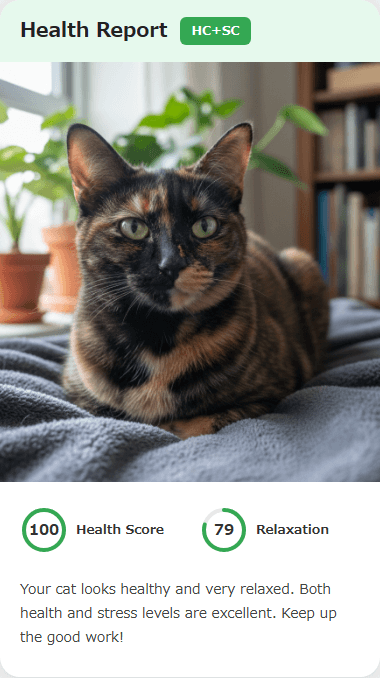

Wondering if this applies to your cat?
Just read the news? Check your own cat now with CatsMe — one photo, instant AI health score.
Used by 380,000+ cat owners in 50 countries


Category 1: Veterinary Diagnostic AI (Imaging, Blood Analysis)
Major players:
- SignalPET (US) — X-ray AI analysis, received FDA de novo clearance in March 2026
- PicoxIA (France) — X-ray and CT AI diagnostic support
- Vetology (US) — X-ray analysis, deployed in 500+ US veterinary hospitals
- Anicom Advanced Medical Research Institute (Japan) — AI interpretation of blood test results
Technical approach:
- Trained on veterinary X-ray, CT, and MRI images
- Detects cardiomegaly, pulmonary edema, fractures, tumors
- Assists (not replaces) veterinarian final diagnosis
Published accuracy benchmarks (2026):
- Cardiomegaly detection: 94% sensitivity / 91% specificity
- Pulmonary edema detection: 89% sensitivity / 95% specificity
- Fracture detection: 97% sensitivity / 98% specificity
Cost:
- Veterinary hospital side: ¥30,000-100,000/month subscription
- Owner side: Added to clinical fee (¥1,000-3,000 per scan)
What it means for owners:
Functions as an insurance policy against vet oversight. However, AI doesn't replace diagnosis — making AI adoption an absolute requirement for vet selection is premature. The ideal is experienced vet + AI assistance.
Category 2: IoT Continuous Monitoring (Collars, Litter Boxes, Water Fountains)
Major players:
- Tractive Cat Mini (Austria) — GPS + activity tracker, 29g lightweight collar
- Catspad (France) — Smart water fountain measuring drinking volume
- Petivity (US, Mars) — Smart litter box tracking weight, urine volume, and frequency
- PETLIBRO Smart Pet Feeder — Auto-records food intake and frequency
Technical approach:
- Physical sensors (accelerometer, weight, flow rate)
- Data aggregated to cloud via Bluetooth/Wi-Fi
- Smartphone alerts on anomaly detection
Early signs detectable:
- Increased water intake → chronic kidney disease, diabetes, hyperthyroidism
- Weight loss → CKD progression, cancer, hyperthyroidism
- Increased urination frequency → FLUTD
- Reduced activity → joint disease, systemic illness
Cost:
- Initial: ¥15,000-50,000
- Monthly: ¥0-2,000 (cloud service)
Cautions:
- Multi-cat households struggle with 'whose data is this' identification (RFID-microchip-aware models are expensive)
- Some cats reject collars; entanglement accident risk exists
- Smart litter boxes may not match existing litter preferences
What it means for owners:
Powerful tools for catching changes, but many owners drown in data. Pick one and use it for 3 months is a realistic starting point.
Category 3: Photo-Based AI Health Analysis (Including CatsMe)
Major players:
- CatsMe (Japan/Carelogy) — Analyzes facial expressions from photos to generate health score
- TTcare (Korea) — Disease risk from photos of eyes, nose, teeth, skin
- Pawscout — Face recognition for individual ID + health records
- Sylvester.ai (Canada) — Auto-calculates Feline Grimace Scale (FGS) pain score via AI
Technical approach:
- Smartphone photo + cloud inference
- Detects expression, posture, body part abnormalities
- Designed for easy daily owner habituation
Differences from other categories:
| Aspect | Vet Diagnostic AI | IoT Monitoring | Photo AI |
|---|---|---|---|
| User | Veterinarian | Owner (passive) | Owner (active) |
| Data | Medical imaging | Sensor time-series | Photos |
| Frequency | At clinic visit | 24/7 continuous | Owner's choice |
| Cost | Medium (via clinic) | Medium-high (device) | Low (app) |
| Strength | High-accuracy diagnosis aid | Early anomaly detection | Habit + awareness |
| Weakness | Requires AI-equipped clinic | Operational burden | Subjective photo quality |
Photo-based advantages:
- Start immediately with just a smartphone
- Quantifies the owner's 'something seems off' intuition
- The act of photographing itself promotes health observation habits
- Easy per-cat tracking even in multi-cat households
Photo-based limitations:
- Results vary with photo angle, lighting, focus
- Internal disease undetectable until externally visible
- Final diagnosis still requires a veterinarian
Conclusion: The 3 categories are complementary, not competitive
- Daily monitoring → IoT or photo AI
- When something feels off → photo AI for initial assessment
- During vet visit → diagnostic AI assists
This 3-layer structure is considered the ideal cat healthcare setup for 2026.
Practical Selection Guide for the Japan Market
Recommendations by lifestyle:
① Busy single household (short at-home time)
- Main: Photo-based AI (CatsMe) — morning photo for health check
- Sub: Smart water fountain — auto-tracks intake
- Monthly: ¥0-500
② Multi-cat household (3+ cats)
- Main: Photo-based AI — easy per-cat records
- Sub: Microchip-identifying smart litter box
- Monthly: ¥1,500-3,000
③ Household with senior cat (11+ years)
- Main: Photo-based AI + smart scale
- Sub: IoT collar for activity monitoring
- Monthly: ¥1,500-2,500
- Recommended: Don't skip biannual health checkups
④ Cat with chronic disease (CKD, diabetes, etc.)
- Main: Regular exams at AI-equipped veterinary clinic
- Sub: Photo-based AI + smart water fountain for at-home monitoring
- Monthly: ¥500-2,000 + regular clinic costs
3 selection principles:
1. Sustainable as a habit? — Things cats hate or owners find tedious won't last
2. Vet collaboration possible? — Report export features are very helpful
3. Clear personal data and photo handling? — Verify the privacy policy
Start AI Health Management from a Single Photo with CatsMe
Among growing cat AI options, CatsMe occupies the position with the lowest barrier to entry and the highest habit-forming ease.
CatsMe features:
- Health score from a single photo via expression and posture (proprietary AI, peer-reviewed)
- Used by 100,000+ in 47 countries, data-driven updates
- AI chat consultation for instant 'is this okay?' check
- Connection to online vet consultation
- Per-cat records for multi-cat households
- 3-day free trial (annual plan)
Combine with other IoT devices:
Pair sensor data from smart water fountains or litter boxes with CatsMe photo records to simultaneously track 'numeric anomalies' and 'visible changes'.
Try CatsMe's 3-day free trial →
Stay ahead of your cat’s health
CatsMe automatically logs daily health scores you can share with your vet in one tap — so you’re never left guessing.
AI診断ペットテックFDA承認スマート首輪ヘルステック2026
FAQ
 CatsMe
Be ready the moment you sense something's off
Take one photo and the AI reads pain and condition from your cat's expression. Check the moment you wonder, and share the record with your vet.